Description
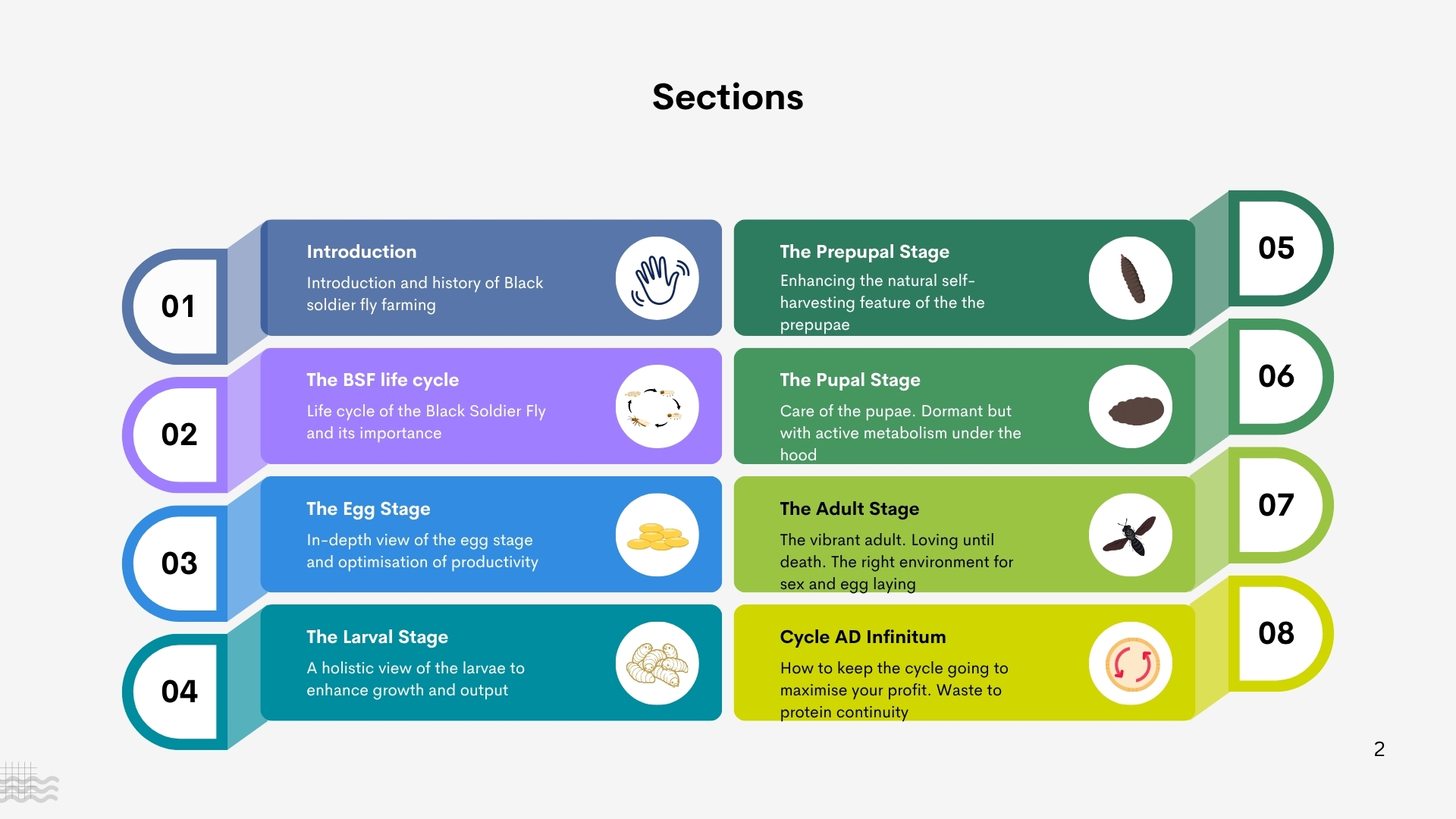
Written by the owners of Las Point Farms, this handbook is the ultimate practical guide to Black Soldier Fly farming available online today. It carefully covers everything from the insect’s life cycle and rearing practices to environmental management and waste-to-protein optimization. Readers are guided step-by-step through a failsafe methodology designed to eliminate the common, costly mistakes beginners usually make.
Black Soldier Fly Life Cycle and Development Stages
The BSF life cycle includes eggs (3-4 days), larvae (10-14 days), pupae (8-14 days), and adults (5-8 days). Each stage has specific environmental needs for optimal growth.
Mastering the cycle allows for maximizing waste conversion and protein production by controlling temperature, humidity, and timing at each stage.
Egg Production and Incubation Optimization
Females lay 500–900 eggs in crevices near food sources; maintaining 60–70% humidity and 27–30°C temperature ensures high hatch rates.
Incubation involves suspending eggs over a moist substrate; optimal conditions produce synchronized hatch within 3.5 days, doubling neonate survival rates.
Larval Growth and Feeding Strategies
Larvae go through six molting stages, grouped into neonates (days 1–4) and active feeders (days 5–14). Proper diet and environment are critical for rapid growth.
Diet quality, particle size, moisture (70%), temperature (~30°C), and stocking density (2–5 larvae/cm²) influence growth speed and biomass yield.
Environmental Control for Larval Development
Maintaining 30°C and 60–70% humidity maximizes larval activity. Excess heat from high densities can reach lethal levels.
Adequate airflow and moisture management prevent anaerobic conditions and odor issues, improving conversion efficiency.
Equipment and Facility Design
Use shallow, wide bins with proper bedding (wheat bran or poultry mash) for neonates. Grow-out bins should be shallow (15–20cm) with collection ramps for self-harvesting prepupae.
Automated systems like V-Bins with ramps facilitate large-scale processing, reducing labor and ensuring clean separation of prepupae.
Pupal Environment and Care
Pupae require dry, loose substrates (wood shavings, sand) at 27–30°C and 60–70% humidity. Proper conditions ensure healthy emergence.
Synchronizing emergence within 48 hours involves maintaining steady temperature; cooler storage can stagger fly release.
Adult Fly Management and Mating Behavior
Adults live 5–9 days, do not eat but need water, high temperatures (28–32°C), and UV/blue light for mating.
Managing crowding, providing resting spots, and controlling light and humidity optimize activity and egg-laying.
Mating and Egg-Laying Conditions
Females prefer shaded, fermenting scents and dry, crevice-like egging sites. Proper lighting (UV-A, blue) and environment trigger oviposition.
A “Love Nest” with vertical mesh, high-intensity lighting, and misting maintains hydration and encourages egg deposition.
Lifecycle Continuity and Self-Harvesting Techniques
The cycle is designed to be perpetual with controlled environments for each stage. Neonates hatch in a starter feed mix of wheat bran, water, and optional sugar.
Self-harvesting prepupae use ramps to migrate into collection bins, eliminating manual sifting and increasing efficiency.
Key Parameters for Optimal Production
Maintain temperature 28–32°C, humidity 60–75%, and light spectrum in the blue/UV-A range at 10,000 lux.
Proper management of feed, environment, and equipment ensures high survival, rapid growth, and efficient waste-to-protein conversion.
Larvae Development and Inoculation Process
Larvae grow to 3–5mm, about the size of a rice grain, and are inoculated into V-Bins with larvae and leftover bran.
Maintaining optimal conditions (creamy white color, activity) after 5 days confirms healthy larvae.
Nursery Management and Success Factors
Use fine bran, maintain 70% moisture, moderate ventilation, and proper depth (5 days) for neonate growth.
Dry, loose sawdust facilitates larvae exit shells; daily nursery checks ensure health.
Facility Layout and Climate Control
Four zones: Intake (Zone A), Larval Grow-Out (Zone B), Nursery (Zone C), Post-Processing (Zone D).
Climate: 28–30°C, 70–80% humidity, high ventilation, and hygiene prevent odors and contamination.
Daily Operations Schedule
Mornings focus on breeding, egg harvesting, and nursery inoculation.
Midday involves waste intake, grinding, and larval feeding.
Evenings include misting, cleaning, and maintenance to sustain productivity.
Infrastructure and Environmental Requirements
Reliable 24/7 electricity, high-pressure water, sealed floors, and air exchange every 15–20 minutes are essential.
Proper infrastructure supports continuous, odor-managed operation.
Biological Lifecycle and Productivity Optimization
Eggs hatch in 3–4 days, larvae grow for 10–14 days, then pupate.
Conditions like temperature, humidity, and feed recipe optimize growth, mating, and pupation.
Fly Emergence and Egg Laying
Pupae are placed in dark chambers; adults emerge through PVC pipes toward light.
Love cages with attractants promote mating and egg laying, ensuring cycle continuity.
Waste Processing and Harvesting
Monitoring and Maintenance Tips
Process 50kg waste daily, with self-harvesting larvae in V-Bins.
Frass is removed regularly; 5% of prepupae are used for fly breeding, remaining for sale or feed.
Dead flies (>50 in 3 days) indicate humidity or heat issues.
Larvae should shimmer when tapped; record-keeping helps optimize productivity.
Reviews
There are no reviews yet.